COVID-19 AND OVERALL IMPACT
The Covid-19 pandemic has hit the world at a scale and speed that we have only seen so far in doomsday movies. Truth, as we are seeing it today, is way more frightening than fiction. The effect of the corona virus is going to be unimaginably high. Worse, it’s going to end up having a long tail too.
The Novel Covid-19 virus is now completely entrenched in the global economic system if not the society at large. In India , As a preventive measure, the government has ordered a total shut down across the country which will soon affect every individual both directly and indirectly.
Based on what has transpired in other countries it can be concluded that nothing much can be done and depending on how long the virus proliferates the economic impact will be even more severe. The government and central bank can at best try and alleviate suffering but cannot provide a cure and the damage to the economy will be deep.
Since then, Covid-19 risks have been priced so aggressively across various asset classes that some fear a recession in the global economy may be a foregone conclusion.
Business leaders are asking whether the market drawdown truly signals a recession, how bad a Covid-19 recession would be, what the scenarios are for growth and recovery, and whether there will be any lasting structural impact from the unfolding crisis.
2019 joint report from the World Health Organization (WHO) and the World Bank estimates the impact of such a pandemic at 2.2 per cent to 4.8 per cent of global GDP (US$3 trillion). That was well before the world knew of Covid-19.
In truth, projections and indices won’t answer these questions. Hardly reliable in the calmest of times, a GDP forecast is dubious when the virus trajectory is unknowable, as are the effectiveness of containment efforts, and consumers’ and firms’ reactions. There is no single number that credibly captures or foresees Covid-19’s economic impact.
Instead, we must take a careful look at market signals across asset classes, recession and recovery patterns, as well as the history of epidemics and shocks, to glean insights into the path ahead.
CURRENT AND FUTURE IMPACTS ON INDIAN ECONOMY
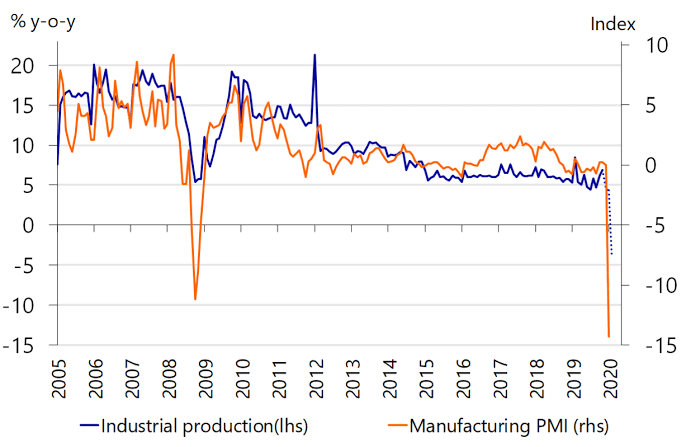
It does not require an economist to tell that a complete social and economic lockdown of India for 21 days would severely impact the supply side of the economy, that is, production and distribution of goods and services, except for the essential items that are exempt.
In an economy already reeling under a demand depression, rising unemployment, and lowering of industrial output and profits, all of which happening together for several quarters now, a supply-side constraint would deliver a big blow, jeopardising growth prospects and social and economic wellbeing of a large number of people.
At the moment, it is a supply-side problem. Both production and distribution of non-essentials have come to a halt. This affects at least 55% of the economy for three weeks or about Rs 2 lakh crore. It may even be larger due to previous partial lockdowns by various state governments.
Now, after the lockdown is lifted, there will quite possibly be an increase in sales which will be met through existing inventories. This does not, however, add to the GDP (as these goods and services had already been produced and accounted for). It may take a few more months for the final production and sales to resume.
REVIVAL OF COVID-19 INDIAN ECONOMY.
The economic cost of social distancing being practised in order to prevent the spread of coronavirus. Not just the daily-wage labourers, but small businesses as well as freelancers and those operating in the gig economy are equally feeling the heat. Of course, big business is also bearing the cost of social distancing. But big business has the money and the scale to survive the crisis.
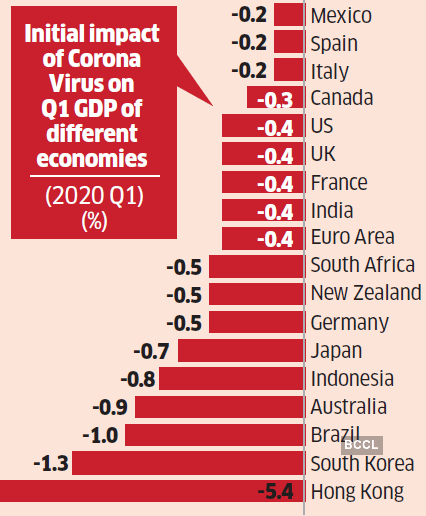
All this is expected to pull down economic growth in India between April and June 2020. Of course, growth is expected to fall across the world. Governments across the world have come up with rescue packages to deal with this expected slowdown in growth. The idea is to put some money in the hands of people and encourage them to not cut down on their consumption.
In such an environment, universal basic income (UBI)-like measures will help quite a lot. The Australian government has announced that a cash payment of $750 (Australian dollars) will be made to six million low-income earners. American politicians are also discussing a one-time payment of $1,200 for individuals earning up to $75,000 a year.
UBI-like options for India
Let’s take a look at some similar measures which can be possibly implemented in India.
Advance payment of pensions: This is something that the Kerala government is planning to do. Two months of pension is to be paid in advance. Over and above this, ₹1,000 will be paid to families not eligible for pensions. In a statement released to the press, economist, Jean Drèze has suggested that “advance payment of (at least) three months’ pension should be made immediately, to help widows and the elderly who are the most vulnerable in this crisis.”
Payment into Jan Dhan accounts: Currently, there are 382.6 million Jan Dhan accounts. The central government can directly transfer money into these accounts. At ₹2,000 and ₹3,000 per account, the total bill for the government will work out to ₹76,520 crore and ₹1.15 trillion, respectively. This will be a really mass-market measure that can help the poorest of the poor.
Advance payment of PM-Kisan amount: The Pradhan Mantri Kisan Samman Nidhi (PM-KISAN) scheme provides ₹6,000 per year per family to all farmers who own land. The government can pay two out of the three instalments for 2020-21 at the beginning of the year.
Payment to daily-wage labourers: The Uttar Pradesh government has decided to pay ₹1,000 to 2.037 million construction workers registered with the labour department and 1.5 million self-employed cart owners, small shop owners and rickshaw-pullers. The money will be paid through direct benefit transfer system. Other states can easily replicate this depending on the kind of data they have for construction and other workers.
There are other non-UBI measures also which can be taken.
Increase of allocation of rice and wheat provided through the public distribution system (PDS): The Food Corporation of India has stocks of 58.497 million tonnes of rice and wheat as of March. This is much more against the mandated 21.41 million tonnes, which includes operational as well as strategic stock. This excess rice and wheat can easily be distributed through PDS all over the country. The Delhi government is planning to implement something along these lines.
Delay goods and services tax (GST) payments: In the UK, business needs to pay the value added tax (VAT, which is similar to GST), up until middle of June. This VAT can be paid up until the end of 2020-21. A postponement in payment of GST in India is highly unlikely given the government’s huge dependence on the tax. During 2019-20, the direct tax collections (corporate income tax and personal income tax) haven’t been up to the mark. There is no reason to believe that this is going to change in the early part of 2020-21. Hence, postponing GST payments will be very difficult.
Nevertheless, something can be done to ease the pain on smaller entrepreneurs. Currently, GST needs to be paid after the invoice has been raised, irrespective of whether the payment has been made or not. This needs to change to where the GST has to be paid only once the bill has been paid. This will help small businesses with their working capital not getting stuck
Clear all government dues: The Kerala government has announced a relief package of ₹20,000 crore. The biggest entry in the package is that of the government clearing all its dues. This amounts to ₹14,000 crore. This can be implemented at the national level.
Increase in allocation to Mahatma Gandhi National Rural Employment Guarantee Scheme (MGNREGS): In 2020-21, the allocation to MGNREGS has been cut to ₹61,500 crore against ₹71,002 crore in 2019-20. This is primarily because as the government moves towards UBI-based payments, it is trying to cut down on allocations to other social sector schemes, without withdrawing them. With many daily-wage workers in cities heading back home, work needs to be created in the villages. In order to do that the allocation to MGNREGS needs to go up. Drèze also suggested that a higher daily wage be paid for work offered under MGNREGS. Clearing the current MGNREGS dues will also be a huge help.
Change the definition of bad loans: The slowdown in economic activity will end up impacting small businessmen from infrastructure contractors to road transport operators to taxi aggregators to traders. These businessmen along with other micro, small and medium enterprises, have taken on loans from non-banking finance companies (NBFCs) and banks. Some of these businessmen, with excellent track records up until now, are likely to default in the days to come, as business dries up. Hence, the NBFCs and banks need to be lenient on them and defer the payment of EMIs
This will only become possible, if the definition of bad loans or non-performing assets is changed. Currently, a bad loan is defined as a loan which hasn’t been repaid for a period of 90 days or more. This needs to be extended to 180 days in case of smaller businesses.
Positive Impact of COVID-19 on India Inc.
Besides the massive social disruption that COVID-19 has caused in the last few weeks, there has also been a significant—and adverse—economic impact. Many companies and organizations have had to re-evaluate their business continuity plans and exigency strategies. Faced with uncertainty, several employers are still in the phase of fully understanding the situation and learning lessons from the rapidly unfolding events. There are new concerns, questions and reactions that range from acceptance and adjustments, to panic and pessimism.
Yet, every crisis contains deep within itself the seeds of new opportunities and solutions. Businesses and organizations can use these times to re-evaluate their goals and approaches and re-strategize the way forward with innovative measures to boost their dynamics with employees, stakeholders, investors, partners and others in the ecosystem. This is especially critical as traditional work patterns are under a cloud, with employees increasingly opting to—and demanding—work from home, and governments advising companies to introduce ‘telecommuting’ as a measure to ensure the safety and well-being of employees.
While introducing ‘work from home’ measures, it is critical for teams to establish ‘ground rules’ on key aspects—ranging from connectivity and goals, critical tasks, ensuring streamlined communication and coordination as per individual roles and multi-tasking. Clarifying goals is important in the wake of shifting work patterns, to enable teams to revisit their tasks as per institutional objectives, employee roles, and the envisioned outcomes. This also helps in putting forward a peer-led rather than leader- or boss-driven model with increased communication and engagement within the group of workers. Focusing on multi-tasking and the ability to manage multiple teams and projects will be an essential requirement and an asset for employees, and due emphasis should be placed on this.
Understanding that these are extraordinary times and an unprecedented situation is crucial for operational heads and employers, especially when it comes to helping employees cope with anxiety and stress. Some may find working from home somewhat unnerving and feel disconnected, which in turn affects the productivity and engagement with colleagues. To overcome these challenges, the need for personal interaction led by employers is more important than ever. This can be done through regular virtual meetings, telephonic interactions, video conferencing and mobile messaging apps. These allow more personal interactions (unlike in formal emails), allowing team members to read one another’s emotions, and boost morale and mental health in these trying times.
“Man needs difficulties in life because they are necessary to enjoy the success.”
~A.P.J Abdul Kalam
Thanks!!
K.Trivedi & M.Sodagar.
 APOLITICAL DIPLOMACY